
The Economics of Exploitation
The Zone of InterestThis thread follows the conflict between economic extraction and racial destruction, showing how commercial calculation coexists with annihilation.
increasing Bearing strength in each event
 decreasing
Bearing strength in each eventdecreasingThe Factory’s Promise
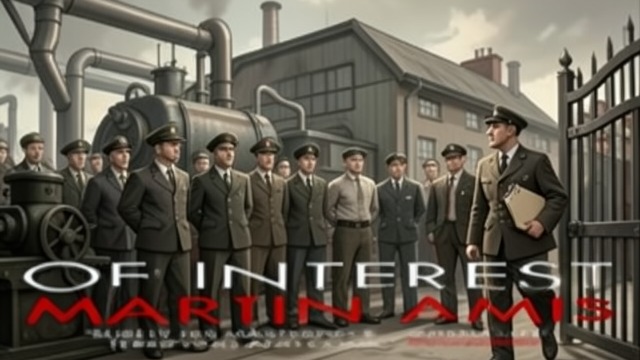
The Factory’s Promise
Autarky as a war aim
Buna-Werke is supposed to produce synthetic rubber and fuel, reducing Germany’s dependence on outside supplies. Its promoters believe industrial output can affect the war’s outcome.
Forced labor underwrites the promise
The factory depends on prisoners whose lives are treated as expendable. Economic ambition and camp violence are not separate policies but mutually supporting parts of the same project.
The Price of a Prisoner

The Price of a Prisoner
People are priced as inputs
A letter from Bayer requests another group of women after a previous group died during anesthetic experiments. Thomsen and Burckl discuss the transaction as a commercial matter.
Profit reaches the body
The correspondence reduces prisoners to a price and a supply problem. The industrial language connects camp administration to medical experimentation and corporate demand.
Burckl’s Efficiency Argument

Burckl’s Efficiency Argument
A business case for better conditions
Burckl argues that food and rest would extend prisoners’ working lives and improve output. He presents a practical alternative to the beatings and starvation that make labor inefficient.
The humane implication is resisted
His argument is framed as productivity rather than a claim to human dignity. Even this limited proposal faces opposition because it conflicts with the regime’s racial priorities.
Thomsen’s Ideological Obstruction

Thomsen’s Ideological Obstruction
Racism answers an economic problem
Thomsen claims that Jews are constitutionally unsuited to work and will not respond to improved conditions. He dismisses the observed evidence in favor of official racial doctrine.
Destruction defeats production
The argument protects the camp’s ideological purpose while weakening the industrial project. The contradiction is not accidental: the state pursues output and annihilation at the same time.
A Factory That Never Produces

A Factory That Never Produces
Managers face judgment
IG Farben executives and managers are convicted in postwar trials for crimes including slavery and mass murder. Their sentences expose the company’s role in the camp economy.
The promised output never arrives
Not a kilogram of synthetic rubber or a milliliter of fuel is produced at Buna-Werke. The failure makes the human cost of the project even more stark: immense suffering served a promised future that never materialized.
Autumn 1942, as Buna-Werke nears expansion
Autumn 1942, when Thomsen reads the Bayer letter
Autumn 1942, during his meeting with Thomsen
Autumn 1942, during the debate over prisoner rations
July 1948, at the IG Farben trial
